
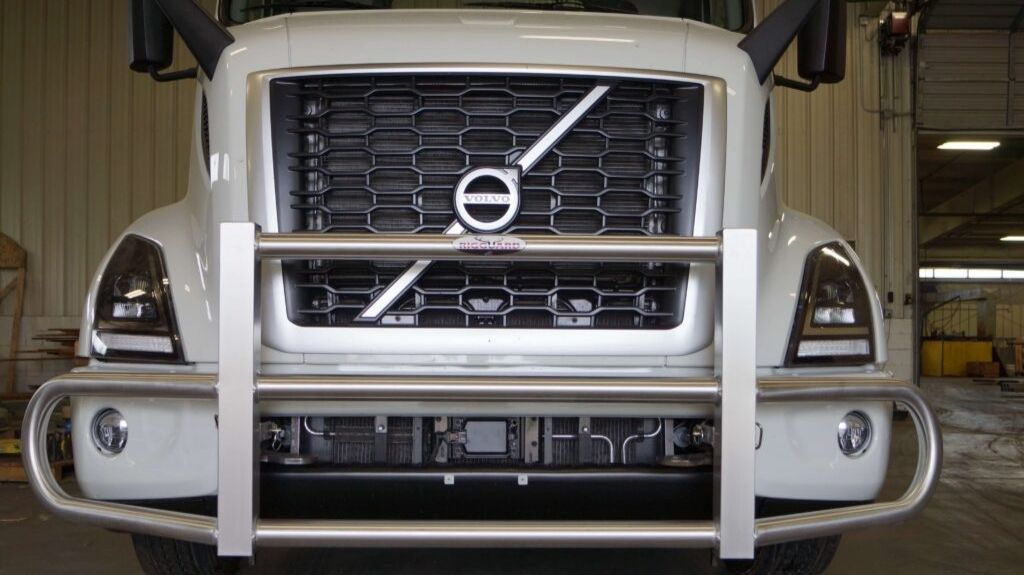
How To Calculate ROI for Grille Guards and Front-End Repairs
Have you thought about purchasing a grille guard for your truck? Are you looking at ways to protect fleet vehicles from animal strikes, road debris, and minor accidents? A high-quality grille guard may be the answer you are looking for, but many potential buyers still want to know if spending the money on a grille guard is worth it in the long run. Learn how to calculate ROI for grille guards and front-end repairs with this quick, in-depth guide created by RIGGUARD.
What Is the ROI of a Semi Truck Grille Guard?
Prices for a brand-new semi truck grille guard will vary based on style, design, material, and finish options that impact the price — which impacts the Return on Investment (ROI) for your grille guard. To better understand the potential ROI that goes with investing in a grille guard for your truck, it is important to examine the real-world costs tied to an accident or animal strike — without a grille guard — compared to the upfront costs of a grille guard for your truck or fleet.
Front-End Maintenance and Repair Costs for Commercial Trucks
When a commercial truck squares off against a 150-pound deer or a larger animal at high speeds on a freeway, the financial costs and implications go beyond a simple dented bumper. To better understand the true return on investment of a semi truck grille guard, you have to look at the hidden maintenance and repair costs that add up the moment a truck is forced off the road:
- Mechanical and Structural Repair Costs: This primary cost refers to the real-world cost of parts, labor, and materials needed to fix the front end of your truck — including the hood, radiator, transmission cooler lines, and headlights. The costs for a replacement bumper alone can range from $500 – $1,500, and those costs add up.
- Average Cost: $10,000 to $16,000
- Advanced Safety Technology Calibration Costs: When advanced collision-avoidance systems are damaged, this cost factor covers the diagnostic, replacement, and recalibration costs for the radar arrays, cameras, and forward sensors, that are housed directly inside modern commercial bumpers.
- Average Cost: $3,000+
- Emergency Towing and Recovery Costs: When a truck breaks down on the highway, it needs to be towed to where repairs can be made. The expenses tied to dispatching a heavy-duty wrecker to haul a disabled Class 8 truck from a remote highway location to the nearest mechanic can add up.
- Average Cost: $1,500 to $3,000
- Operational Downtime Costs: The costs tied to a front-end collision go beyond mechanical repairs and include cost of vehicle downtime, lost production, unfulfilled freight contracts, and driver layover pay for every single day the commercial asset sits idle in a shop and is not moving cargo.
- Average Cost: $448 to $1,200 per day
- Average Repair Time: 2 to 4 days
How To Calculate and Estimate Commercial Truck Repair Costs
When you are armed with a better understanding of the repair and maintenance costs tied to a front-end collision or animal strike, you can use some pretty easy math to calculate the Total Strike Cost for an accident — and when you put that cost up against the cost of a RIGGUARD grille guard, you can determine the return on investment for your grille guard.
Here is a basic formula to help you calculate the Total Strike Cost of an accident:
Towing Costs + Repair and Replacement Costs + (Daily Lost Revenue x Days of Downtime) = Total Strike Cost
Example: $1,500 + $10,000 + ($448 x 4) = $13,292
Calculating the Bottom Line: Measuring Your Grille Guard ROI

To help determine if a commercial grille guard is worth the investment, you need to measure the upfront costs of a grille guard for your truck — or for your fleet — against the potential costs of a front-end collision without a grille guard. While they cannot always wholly prevent damage, high-strength steel and aluminum grille guards can minimize damage (which reduces repair costs) and can prevent downtime by protecting key mechanical elements of your truck and absorbing the impact of a collision. When a single piece of protective equipment — like a semi truck grille guard — can prevent thousands of dollars in repairs, maintenance, and lost production, it is well worth the upfront investment.
To evaluate the return on investment for your own truck, subtract the average cost of a grille guard from your estimated Total Strike Cost using simple math to calculate the Net Incident Savings:
Net Incident Savings = Total Strike Cost – Average Guard Cost
By using the Total Strike Costs from the example equation above — where towing, mechanical repairs, and four days of lost revenue contribute to a hefty price tag — the Net Incident Savings and financial return on a standard $1,600 powder-coated steel guard looks like this:
Net Incident Savings: $13,292 Total Strike Costs – $1,600 Cost of a Grille Guard = $11,692 of Savings
If you use this hypothetical scenario as an estimate, minimizing the damage of just one animal strike or accident by purchasing a RIGGUARD grille guard can save you an estimated $11,692 in net savings — which contributes directly to your bottom line and illustrates how a grille guard can pay for itself many times over in one instant.
READ MORE: How Much Does a Semi Truck Grille Guard Reduce Downtime?
Are you looking for ways to save money for your trucking company and protect the bottom line? A high-quality grille guard may be the answer for you and your fleet, but you may want to know how to calculate ROI for grille guards and front-end repairs. This in-depth overview created by RIGGUARD may help you see the financial benefits of investing in a grille guard.
Contact RIGGUARD today for more information about RIGGUARD grille guards!